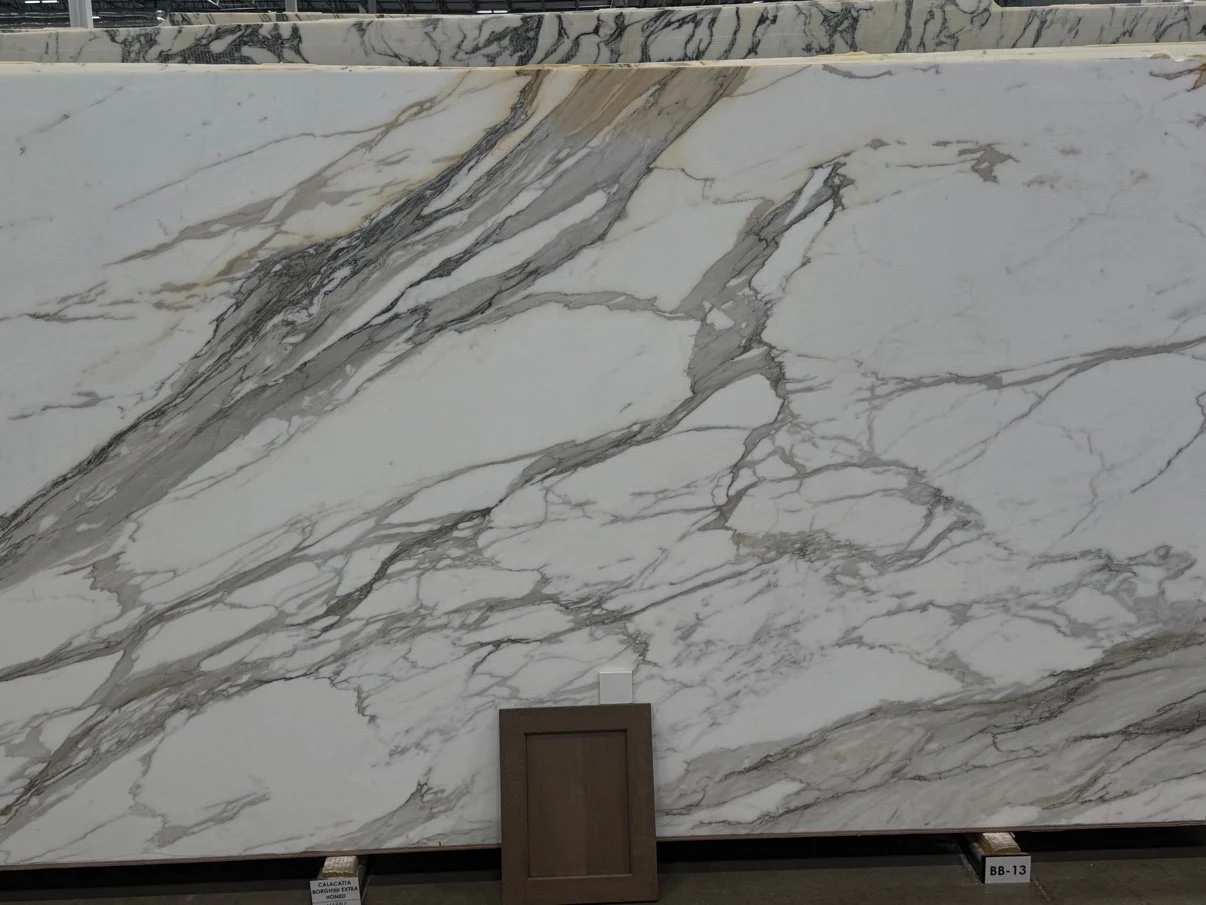
There is a moment at the slab yard that we love every single time. A client rounds the corner of the rack, sees the stone they've been dreaming about, and just — stops. Hand on the slab. That's the one.
Here's what most people don't know: the slab you're looking at in that moment is almost never the slab that ends up in your kitchen. Not because anyone is trying to fool you, but because of how stone is actually cut, shipped, and sold. Once you understand that, you choose differently — and you choose better.
This is what we walk our own clients through before anyone falls in love.
THE FIRST SLAB YOU SEE IS THE COVER
A slab yard buys stone in blocks — one giant piece of the earth, sliced into thirty, forty, fifty slabs. Those slabs travel together as a bundle, and the one on the front of the stack is simply the cover: the face of the bundle, the one that gets shown.
Every slab behind it is a slightly different piece of that same rock. The veining moves. The color shifts — sometimes gently, sometimes enough to change how the whole stone reads in your kitchen. Two slabs from the same block are siblings, not twins.
So when you go: have them move the stack. It is a completely normal request, and it is the only way to see the actual stone you would be buying. Look at your exact slabs, in order, full size — not a sample chip, not a photo, not the cover.
KNOW TWO NUMBERS BEFORE YOU GO
Before anyone falls for a stone, we make sure our clients know two numbers.
The first is how many slabs your project takes. Your fabricator works this out from your layout — island size, counter runs, full-height backsplash, all of it. A stone that works beautifully at two slabs may not exist in the quantity your kitchen needs.
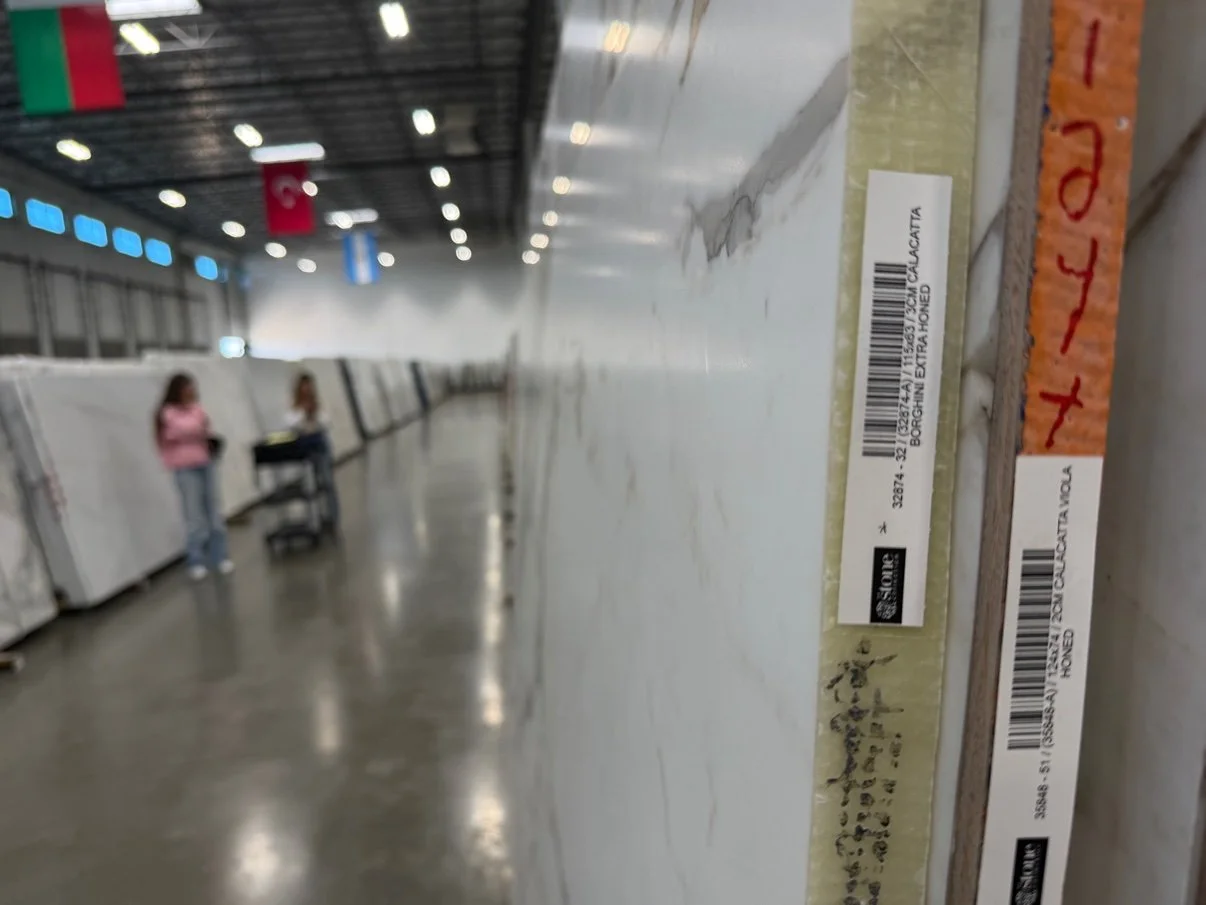
The second is whether your seams need to book-match. When two pieces of stone meet at a seam, book-matching means the veining continues across the joint — where one slab ends, the next picks the pattern right back up, like the pages of an open book. That only happens with consecutive slabs: pieces that were cut side by side from the earth and kept in order. If book-matching matters for your design (and on a statement island, it usually does), those specific consecutive slabs are the ones that need to have your name on them.
CHOOSE WITH YOUR HANDS, NOT JUST YOUR EYES
The same stone can come in different finishes, and they do not live the same way.
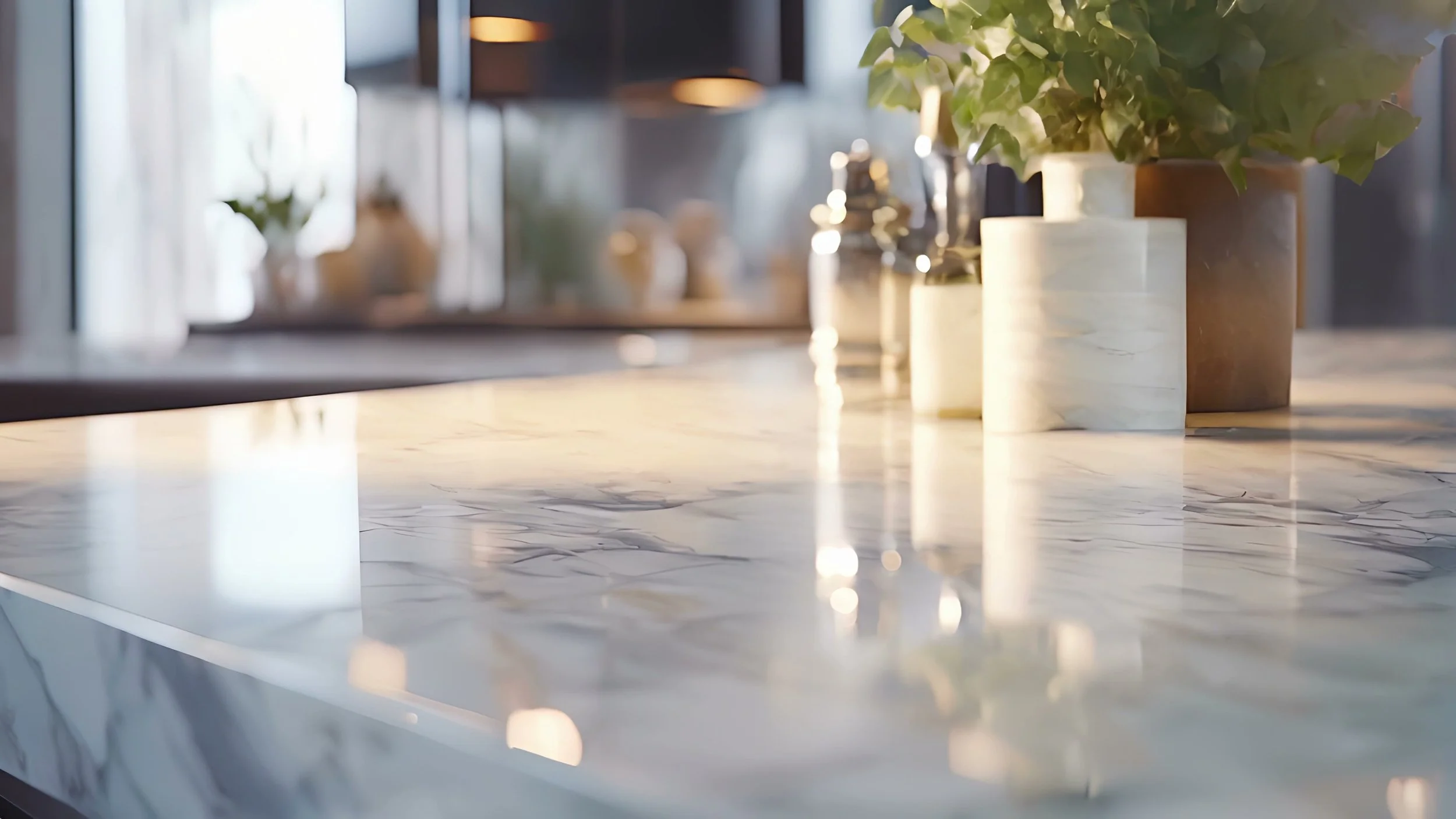
A honed finish is soft and quiet — low sheen, forgiving, with a smooth, natural feel under your hand. A polished finish shines, deepens the color and reflects the light. It adds a shiny, reflective surface to the room. Neither is the "right" answer. But standing in the yard, run your hand across both. Stone is one of the most tactile decisions in a kitchen, and you'll touch your countertops every day for years. Choose with your hands, not just your eyes.
And bring your cabinet door with you. Color only tells the truth in real light, against the actual stone — a door sample that looked perfect at the design center can pull pink, or grey, or green next to a particular slab's veining. We never finalize a stone without the two of them side by side.
THE SLAB YOU CHOOSE IS THE SLAB YOU LIVE WITH
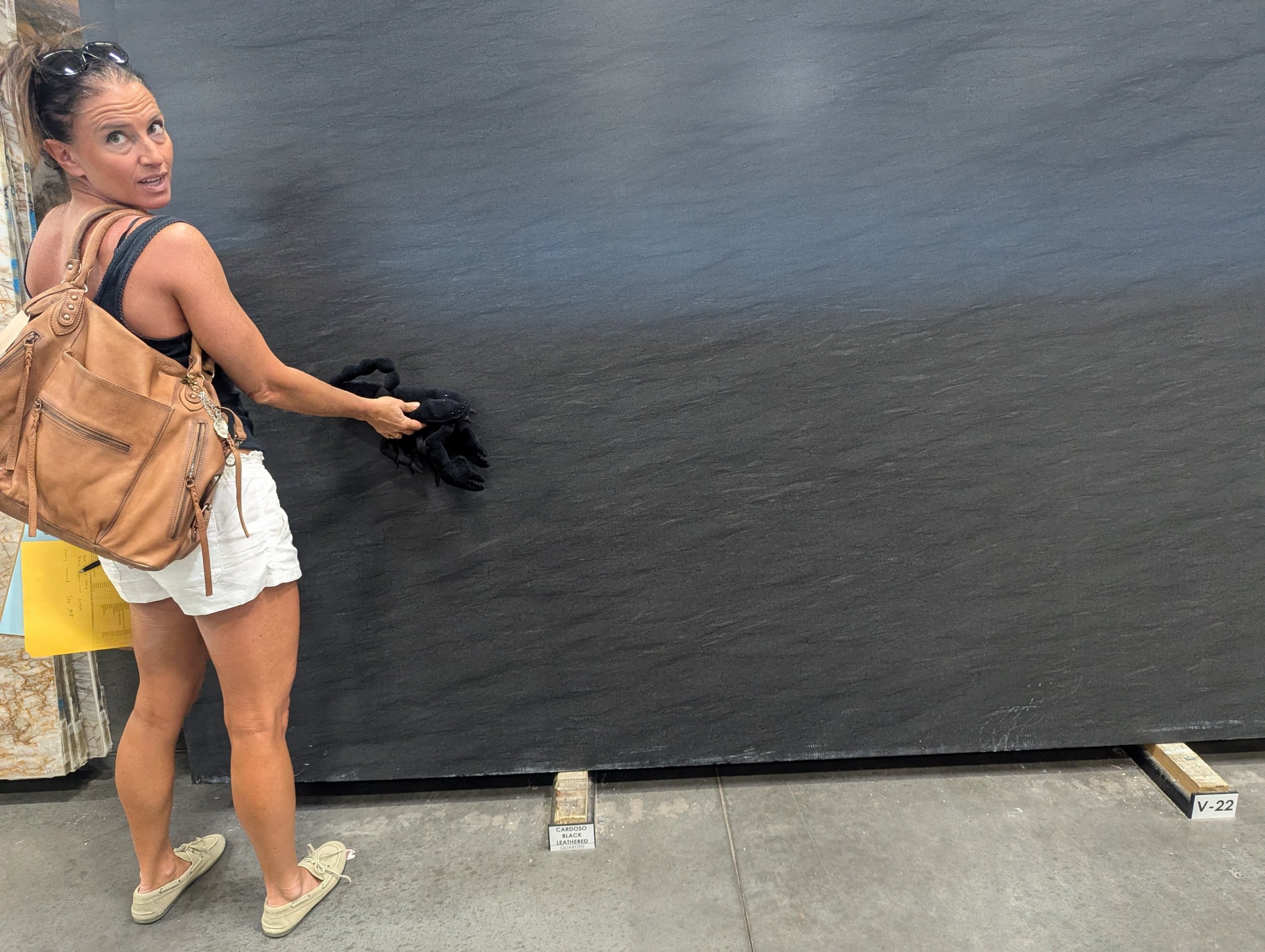
Here is the part we say to every client, because it's the part that matters most: the slab you choose is the slab you live with. Every morning, every meal, for years. Natural stone is not a product that gets manufactured to match a picture — it is a piece of the earth that got cut on a particular day, and yours will be the only one exactly like it.
That's the beauty of it. It's also the responsibility of it. Choose the actual stone — not the idea of it.
This is why we plan the slab yard visit the way we plan everything: early, and together. The stone gets chosen alongside the cabinetry, not after it; the slabs get reserved before someone else falls in love with them; and nobody is standing in a warehouse guessing. Start early. Plan well.
If you're dreaming about a kitchen of your own, let's start with a conversation.
— Leah & Maya, Ever After Interiors · Casper, Wyoming
Keep reading: How to Spot Quality Cabinetry · Which Wood to Choose When Buying Cabinets
